How Do You Feel?

Cue default answer “I’m fine” or “I’m OK”.

True? We all do it. We’ve been conditioned to not share our truth of how we feel – for fear of judgement, burdening others or not being worthy of support – but this lack of honesty means a lack of connection to ourselves and asking ourselves that valuable question of “how do I feel?”.

So ask yourself right now… “how do I feel?” 

Can you identify your emotions? How you’re feeling right now?

The sooner we can become aware of the exact emotions we are feeling, the easier it becomes to manage those emotions and managing our emotions means we can flourish, perform at our best and protect our mental health.

Now don’t worry if you can’t identify your emotions – that’s not unusual – and sometimes we just don’t have the language to verbalise what we feel.

But here’s a little method to try. Take a look at this wheel of emotions and match a word to how you feel.

Next, take a moment to consider what’s going on for you when you identified this emotion. Is what you’re doing in the moment impacting your feelings in the moment? It’s always good to check in with yourself and be aware of what you’re feeling and then you can take action in your life as appropriate.

… and if you’re asking someone else how they are and they reply with “fine” or “OK” – ask them twice… it shows you have an intention to listen, care and are a safe person for them to share with.

Resilience High-5

I write about the importance of resilience a lot… and I will continue to do so! It’s an important aspect of protecting our mental health. But today I thought I’d give you a quick Resilience High-5.

Resilience is not just strength, but the ability to be stretched and then return to form… (think Elastigirl from The Incredibles – one of my heroes because she is resilient AF!)

Resilience is the ability to be flexible, to manage stress, to cope positively and to keep going regardless of what you’re faced with. It is buoyancy – which we need because we all face something hard at some point, whether that is stress, grief or life testing and changing situations.

Resilience is the power to return to form after being bent, compressed and stretched, mentally and physically.

The more resilient you become, the stronger you feel and vice versa.

This is why working on your mental (and physical) resilience is so important for your health and wellness. Being mentally resilient, flexible, stretchy, malleable…whatever word you want to use, will stand you in good stead. You will deal with personal, financial and professional issues much better.

Being resilient will help you learn and flourish from situations and not be broken by them. Being resilient will help protect your mental health and help you be stronger for others.

So here’s my Resilience High-5.

  • Reflect
  • Time-out
  • Focus
  • Create
  • Move

Reflect

Look at what you’ve got through already in your life; if you’re reading this now then that means you’ve got through some stuff so you are already resilient. Appreciate that and be grateful for all you’ve achieved. 

Once you look back at things you can change the narrative going forwards; in effect you can choose not only how to live your life, but choose your mindset and how you respond and act to situations without reacting.

You can face your fears, release regrets, cultivate forgiveness of yourself and others you feel may have done wrong to you and you can learn the lessons to help you develop your strength and resilience.

Time-out

Taking time-out from the busy world, both online and physically, is a good thing. Don’t keep doing things out of habit or impulse.

It is OK and great to do nothing sometimes; we don’t always have to be striving forwards. Being mindful of what’s going on right now and slowing down is good for your mind, body and spirit.

Take time-out for your mental and physical health and to digest what you have learned from your reflection. If things aren’t always working for you, taking a break can really help and don’t be afraid to make changes.

Focus

Reflection done, time-out taken, now it’s time to focus on how you have got through the tough things so far and how you can develop those skills. 

Show yourself plenty of self-compassion and pass that empathy and self-compassion on to others.

Focus on yourself and what you need for your optimum mental and physical health and wellbeing. This is about you and what works for you. Don’t be afraid if it’s different to the needs of others. This is about you and doing the things you love and that make you feel good. 

From walking to meditating, cooking to music, finding new and old things you love to do are therapy for the soul.

Create

Creating and being creative are important for confidence, flexibility and happiness to name just a few reasons.

You have the means to create yourself, your life, what and how you do things and you shouldn’t be shy of ‘re-doing’ you at any time. Passions and values change as we learn and grow, so create yourself as you go along. 

Create a plan of what you want, what you need and how you can implement that and combined with an element of letting things ‘be’ and ‘happen’, you can really bump up your resilience levels.

Having a creative outlet will also help you gain confidence to be the best version of you which you can love.

Move

With your armoury of developed skills, it’s time to move.

Literal physical movement will help to give your mind clarity, improve your wellbeing and mental and physical health but it’s also time to move in a different way; forwards with your life.

There is no speed guidance for this, as long as the direction is forwards, you do you and move at your speed to achieve the satisfaction that you need and want. 

It’s your life on your terms. Work on your resilience and you can navigate life and all its ups and downs with a little more confidence and ease.

Want to chat about your resilience more? Message to book a 15-minute 1-2-1 power call.

A Note on Discipline…

Being disciplined is about respecting yourself enough to put yourself first. Come on, hands up, who’s a people pleaser? I’m definitely not judging you if you are because for most of my life, I’ve been guilty of trying to please everyone and putting other people’s needs before my own, be it my family, friends, colleagues or strangers! Time and time again I would bend over backwards to help others before caring for myself and my own needs and where did it get me? In honesty, not very far at all and really it held me back for so long.

Putting other people’s needs first has driven me to the edge of anxiety and depression. It has made me mentally, physically and financially unwell and unfit and had a huge negative effect on my whole life, my health and my relationships; yet, at the time, the need to be doing things for the benefit of other people before taking care of my own needs seemed more important to me. It was ridiculous really and there was a cycle that the more I did for others, the more normal and OK I thought that was, regardless of what I actually wanted or needed.

Then something changed for me. I got so low and struggled with so much, but with the support of my rather fabulous husband Simon, I slowly started putting boundaries in place and saying no to people. I put my own needs first and got disciplined with myself and others. My boundaries included simple changes such as ‘office hours’ so people couldn’t expect responses at all hours, and I switched my laptop off at a designated time each day. This discipline was my saviour and it gave me time for me. People soon learned what I would and wouldn’t respond to when, and what I would tolerate.

I also prioritised what I needed ahead of work. Each day I schedule my time in before work, whether that’s exercise, reading, meditation, family time or ‘nothing’ time (it’s really good to just do nothing sometimes!), then I’m very disciplined with my to-dos each day – between three and five each day, in two designated work slots. The result? I have more time for me and I work less but I am ultimately so much more productive, successful, healthier in mind and body and happier for it.

That is how and why discipline is vital! It can quite literally save you. My own experience has proved this to me, and you can make small changes for huge benefits as well. 

Need some help with your mindset, setting boundaries or accountability? Then contact us to find out more about The PERFORM Experience ®.

You can also read more in Tabby’s book “The Three Ps: Possibility, Productivity and Performance” here

It Starts With You…

There is a big push for organisations and workplaces to create mentally healthy cultures and as an advocate, coach and trainer of mental health and suicide prevention I am very ‘pro’ developing mentally healthy cultures…

BUT… the responsibility does not only lie with bosses and organisations. As individuals WE have a responsibility to not just spot the signs and symptoms of poor mental health and illness in others and ourselves when they emerge but to actively build our own resilience levels and PROTECT our mental health so we can flourish and be productive, satisfied, successful and happy.

The narrative around mental health is a reactive one, meaning that we wait until stress and burnout and life events see us spiral negatively. We need to shift this narrative to a protective one. One where we charge our internal capacity to manage stress and build our resilience before we experience difficult life events – because those difficult life events WILL come. We will all be exposed to stress or grief at some point. 

You wouldn’t use your mobile phone if the battery was dead – you couldn’t – you’d charge the battery so it was fit for purpose. Not something we often do with ourselves is it? We keep pushing and pushing until breaking point and wonder why we then crumble and feel ill, both mentally and physically.

Protection and prevention is key.

This is why I developed The PERFORM Experience ® – a new way to protect mental health by increasing awareness but by also equipping people with the skills to build their resilience and emotional fitness, boost wellness levels and protect mental health so you can flourish and be more productive on an individual and organisational level.

Our mental health services are over-stretched and under-funded, but with a more protective approach to mental health and wellness that focusses on building resilience and building a toolkit of strategies to be mentally healthy and emotionally fit, we can help alleviate pressure and help people be healthier and happier.

Want to know more about The PERFORM Experience ®? Drop us a message about how we can help individuals and organisations.

The Happiness Mindset

What is happiness? For starters, happiness is a choice. Even during the toughest of times, we can choose to be happy. You can be sad and still experience happy thoughts and events. Happiness can be balanced with other emotions, but it is down to you to choose it.

Why do you want to be happy? Is it because you’re tired of feeling down and negative or maybe it’s because you look at people around you and think they are happier? The truth of people that are genuinely happy is that they have chosen to be that way – they have made a conscious decision to live each day in a happy way.

For me, I make my choice to be happy because I’ve realised and experienced the benefits of that mindset; and that’s all it is, a mindset. If I wake up and don’t make those conscious decisions to be grateful and happy, my day will be unproductive, messy and make me feel down. But if I exercise my power of choice and consciously decide to find the good in each day, starting with first thing in the morning, then I will start my day with a great mindset. I will know things are possible and the day will be rewarding.

So, what stops us? Why do we block our own happiness and sabotage our own lives? Mainly because our default is to not exercise this skill and to let ourselves be overwhelmed by everything going on in our lives.

Why not start your day with a little gratitude? Simply waking up, being alive and able to live another day is reason enough to be thankful and to celebrate. First thing each day, think about what possibilities lie ahead, not what overwhelms you. Train your brain to think in a more positive way. Adjust your mindset to be grateful for what you do have and what you could achieve, before worrying about what you don’t have or can’t do. 

This simple conscious decision could be the starting point of a whole new mindset for you, the one small step that will open you up to inviting more happiness and freedom into your life and the key to a whole new way of living. Stop sabotaging your own happiness and make a choice: a choice to be happy.

Want to know more? Check out Tabby’s book “The Three Ps: Possibility, Productivity & Performance”

Moving our Mood from Low to High

You know those moments when you just don’t want to adult and would rather slump on a sofa with a cuppa and a pussy cat cuddle? 

Well, we all have them. But that feeling of ‘impending doom’ and ‘can’t be arsedness’ doesn’t have to last all day or longer.

Yesterday I felt quite drained, but soon after those feelings, by implementing my tried and tested helpful coping strategies, I was back to being productive and focussed.

So here’s my how. Here’s how I build my resilience to let those low feelings pass freely and quickly and can be much stronger just moments later. Here’s how I carry on whilst living with grief and my own issues and am able to help and support those around me – people like you.

Most important thing? Breathe and don’t fight it. The more we try and suppress emotions or brush them away the worse it is and longer the bad feelings stay. Accept them, embrace them and let them be.

Take the time out for you to process the emotions. Stop what you’re doing, take some alone time, have a cuppa and that pussy cat (or dog, or anything else) cuddle, read something, listen to music, sit in silence, whatever works for you, just simply have a little time to re-calibrate.

Next, write it down. Just a few sentences to acknowledge the feelings can really help. Then read it back, ask yourself how you could think about things differently. Ask yourself if it’s a particular issue that’s upsetting you or simply your response to the issue. More often than not it’s my response to something that causes me more personal pain. It’s not something that’s actually happened to me, just my response, usually when I’ve reacted not acted. 

Talk and share, either to a human or your pet or stuffed toy! Vocalise your thoughts, because when you hear yourself say them, it can help you rationalise things.

Once you’ve done that, which can take anything from just a few minutes, breathe again, pick something easy and productive to do, make a plan and execute that task. The feeling of productivity brings satisfaction and that’s going to raise your mood. It could be anything from putting the rubbish out to doing that admin task that’s been on your To-Do list for the last month (though if it’s been on your To-Do list that long it’s probably not urgent or important so should be scrapped altogether!).

Giving yourself time and being kind to yourself can really help build resilience and building that resilience is going to be what helps you get stronger and more consistently productive and satisfied.

I had my moment yesterday, it didn’t last long and now I’m ready to move forwards, get shit done and do it with a smile. 

We all have these feelings, but they don’t need to define us.

Hope it helps.

Much love 💚
Tabby xxx

Say No to Toxic Positivity

What’s your current mood? As I write this, mine is… happy and content with a hint of excitement and a side note of fear and uncertainty. A true mix of emotions with an overriding sense of positivity.

But I want to mention the words ‘toxic positivity’ to you…

So often we see numerous social media posts telling us to be ‘positive’ and how being ‘grateful’ will help us not feel overwhelm and anxiety.

Now, yes, the practise of gratitude does help develop positive emotions and we should always have hope and optimism and yes, everything I do is based on positive psychology and I will be the first to lift people up and help them.

But I want to call bullshit on some of these positive posts we read because they don’t allow us to be honest with our emotions and make us feel we should sweep our sadness under the carpet and just “be happy.”

They can also bring shame if we’re not feeling totally chipper… which invites a negative spiral into our life.

It doesn’t work like that.

Life is hard and awful and heart-breaking things happen to us all.

We have to allow ourselves to feel all those so-called negative emotions.

We need to feel sad, angry, overwhelmed and anxious.

It is healthy to feel all those things.

We need to have a balance of all emotions so we can learn to manage them, embrace them and move forwards with them, bringing more resilience when tough things face us.

This Pollyanna style positivity of saying things such as “everything will be OK” and “you’ll get over it” are not helpful.

This isn’t positivity. Positivity isn’t saying “everything will be OK” because life sucks and hard things happen and we need to know it’s perfectly OK to feel sad, angry, overwhelmed and anxious.

Positivity is saying “we will be OK regardless of what happens.” 

It’s acknowledging hard things will happen, it gives us permission to feel every emotion we need to (positive and negative) and it encourages action to manage these emotions and move forwards with hope and resilience.

Of course, everything CAN be OK; but that takes work and consistent daily action to protect our mental health and perform.

So, yes… we can all be happy and flourishing and we can do that whilst managing and feeling ALL our emotions along the way, but it’s definitely OK to feel happy, sad, joy, overwhelm, hope, anxiety, fear and every other emotion you want and need to feel at any time.

Much love
Tabby x

My Whole Self

The 14th March is My Whole Self Day, promoted by Mental Health First Aid England and this year focuses on a campaign for workplace culture change.

In order for our workplace and organisational cultures to be mentally healthy, this requires an individual commitment from everyone to prioritise their own mental health and emotional fitness.

When life gets full and busy it’s very easy for us to not prioritise ourselves and our own needs, but in order to manage those inevitably difficult situations which will likely come our way, we need to make sure we have capacity to manage and do the work to protect our mental health and not just react when we are already experiencing the symptoms of burnout.

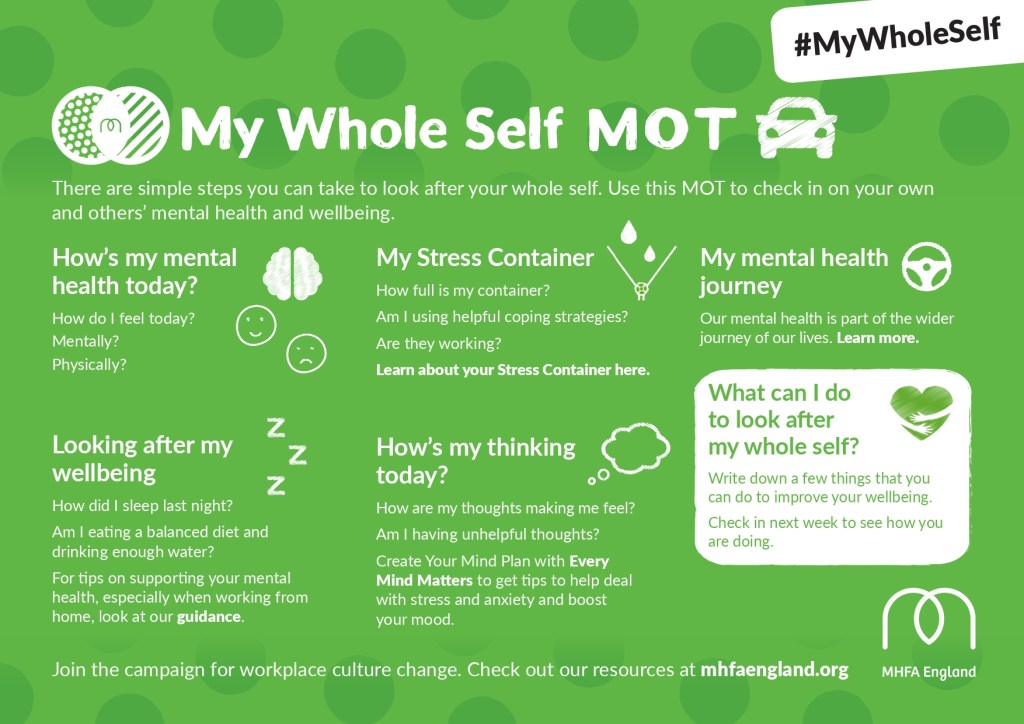
This #mywholeself day, as well as encouraging your workplace or organisation to support the campaign for workplace culture change, why not use it as a reminder to check in on your own mental health and give yourself a My Whole Self MOT?

Ask yourself questions such as How do I feel? How did I sleep? How full is my stress bucket? How is my thinking?

Write down your thoughts and make a commitment to check in with yourself again next week.

You wouldn’t use your mobile phone if the battery wasn’t charged – you couldn’t use it – so apply the same mindset to yourself. Charge your battery before you experience stress and difficult events so you have capacity to deal with it. Change the narrative to protecting your mental health and not just reacting to mental health issues when they arise.

For more information on My Whole Self Day visit www.mhfaengland.org

Much love,
Tabby x

Waking up with Horns!

Three simple steps to changing your mindset in a morning

I was just heading out for a walk when I stopped to check my hair and for lack of a mirror I used my camera phone.

I immediately noticed I’d grown horns! 

I mean, I hadn’t literally grown horns; it was actually the wicker Highland cow head hanging on the wall behind me!

It got me smiling… and then thinking! Some people wake up in the morning and they feel like they’ve actually grown horns and by that I mean, they feel their mood is terrible. They’ve woken up on the wrong side of the bed, or they’ve woken up that way out

The fact is how we feel is down to us; it’s down to our mindset, and we can change our mood if we wake up feeling less than tip top. But sometimes it’s just easier to wallow in self-pity, be in a foul mood and go through the whole day letting it affect everything. That’s not productive to anyone though, least of all you. So how do we shift our mindset quickly, easily and simply when we have a morning feeling that way out

When you wake up feeling bad, or sad, or maybe anxious, what can we do? 

Here’s three simple exercise to change your mindset and your mood.

First of all, start with the basics and go back to focussing on breathing. The most basic thing that we need to stay alive and something that really connects us to our body and mind. It helps boost our mood, de-escalates our heart rate, and it regulates everything that’s going on with our body. Just a few rounds of breathing exercises can be really beneficial for your physical and mental health. 

Try this Box Breathing exercise. 

  • Breathe in over a count of 4 beats
  • Hold the in breath for 4 beats
  • Breathe out over 4 beats
  • Hold the out breath for 4 beats

Repeat 4 times. 

How do you feel?

The next thing you can try is a grounding exercise and this is good if perhaps you’re feeling a little bit anxious when you wake in the morning or perhaps worried about something that’s coming ahead. All the time that you’re worried about what’s coming in the future, or maybe worried about what happened in the past, you’re not focusing on the here and now which is where you are – planted in the present. So we want to bring our senses back to the present moment, engage in them, feel them and this will help reduce any feelings of nerves and anxiety. 

Try this Grounding Exercise.

Take a deep breath and focus on…

5 things you can see

4 things you can touch

3 things you can hear

2 things you can smell

1 thing you can taste

How was that? How do you feel?

What about if you’re just feeling low or flat and lacking energy? If you’re feeling lethargic or you can’t be bothered, or have no motivation? Well, if you wake up feeling like that and you don’t do anything about it, you’ll likely feel that way all day, meaning that your whole day will be unproductive. It might even affect relationships with others or the work you do so what we need to do is change our state – change our mindset – because our state of mind dictates our story. We can actually choose to feel in a better mood and have a higher energy and we can do this by literally moving physically.

So get moving, just for 15-30 seconds. Dance around the kitchen, stretch, pump your hands and arms upwards to the sky quickly whilst deep breathing, plant one foot in front of the other on the floor as if in a running stance and fire your arms in a sprint running motion – but without moving your feet.

Just this quick burst of movement can change your mood because it raises your energy levels.

Simple, but effective exercises for anyone to use.

Here’s a bonus exercise for you…

The truth is that your mood and emotions possibly started as a hangover from the day before. I don’t mean hangover in terms of having drunk too much alcohol (though that could be the case). What I mean is a hangover from what happened in your life the previous day – your mood when you went to sleep – which possibly meant you didn’t sleep very well, and that’s part of what is affecting you now. 

So let’s start with the night before. What can we do before we go to bed to help our mood the next day? Well, here’s a really simple exercise. 

Try this Gratitude exercise.

Before you go to sleep, write down three things that you’re grateful for that happened during the day. No matter how bad your day has been, there will always be something that you can be grateful for. Write them down and read them over a few times. Feel that feeling of gratitude absorbed into your mind and body. This is a really good way to raise your positive emotions so you fall asleep in a better mood, meaning you’re more likely to wake up in a better mood… and that means having no horns in the morning!

Let me know how you get on!

Much love,
Tabby x

People

People can make us or they can break us, whether that’s in business or our personal lives. This is one thing in life you can guarantee…along with death and the tax man!

I’ve taken this life class, the one where you discover what people can really do to you, the result being I pretty much lost everything; materially, physically, financially but most of all mentally. The actions of so-called ‘friends’ left me in a place I never thought I’d be, and once I was there it felt like a place I would never escape from. Why did they do this? Probably because they’re human, they can, it’s easier to destroy someone else than admit your own inadequacies. 

But over time it’s taught me how to deal with people in both my personal and business life. How to negotiate characters, how to differentiate good from bad, useful from harmful and so on; but most importantly how to be around people that are good for me and be brave enough to remove myself from the company of those that are not.

People are one of the biggest motivators or biggest drains on our lives. They can support, encourage and inspire us to great things but in equal measures they can drain us mentally, physically and financially.

Who are Some of the People in Our Lives?

* family 
* friends
* clients
* colleagues
* employees
* competitors

What are some of the things they require from us?

Family

* un-conditional love
* expectations to be there for them and do everything at any time
* cooking, cleaning, shopping…all domestic duties
* earn money, pay bills, give out pocket-money
* control arguments, fight fires (not in the literal sense)

Friends

* understanding
* expectancy to be on ‘their side’
* someone to rely on in tough times & someone to share fun times with
* a 24-hour support network
* validation
* trust and respect

Clients

* help & support (24-hour)
* validation
* expect you to go above and beyond
* fairy Godmother/father
* perfection

Colleagues

* help & support
* having ‘their back’
* trust and support
* mutual regard
* high expectations

Employees

* help and support and ‘hand holding’
* training & mentoring
* trust
* praise

Competitors

* competition
* failure
* inspiration
* validation
* clients
* mistakes

We can be in contact with all these people in any one day and this makes for an awful lot of different demands from many people of just one person; you.

This is physically and emotionally draining and the demands placed on us affect us in so many different ways.

How do People Affect Us?

* our feelings
* the support (or lack) of us
* make us or break us
* success or failure

Think about someone you have had close contact with today, it may be a friend or family member, client, colleague, employee or competitor. 

* what did they require of you? 
* what did you give them?
* how did you make them feel?
* what did they give you in return?
* how did this make you feel?

How do we Manage These People?

When different people want so much of us we have to learn how to manage these people. We can’t burn ourselves out for the benefit of everyone else. It’s time to put yourself first. So, here’s a few hints on how to manage people:

First up, look after yourself or you’re no good to anyone. Eat well, exercise, sleep, enjoy things in your life. That’s the first way we can start to manage the people in our lives.

Blend: blend what you want and what you need with what you can give.

Don’t give to other people more than you give to yourself.

Be honest and transparent. Don’t tell or give people what they want, tell them or give them what they need.

Match and mirror the behaviours, tone of voice and communication styles of people – this builds rapport.

Don’t match to their energy if they ‘vibrate’ at a lower energy and enthusiasm than you. Lift them up to yours.

Go the extra mile for clients. It will make you feel good.

Don’t be bullied by family and friends. If you don’t or can’t give them what they want, don’t beat yourself up about it.

If you don’t like someone or they are ‘toxic’ in your life, bin them. Don’t be scared to do that to family either. Just because you’re related doesn’t give them the right to break you.

Don’t keep giving second chances to people. There’s only ever one second chance.

Be kind and loving to everyone that deserves it from you.

Be respectful and trusting to those that deserve it from you.

Treat people as you wish to be treated.

Don’t always be the listener. Turn to people for help and support, be that a mentor, colleague or friend.

Be kind to competitors (they’ll hate it for starters!).

Be confident in yourself and your brand, this will help you hold your head high against any ‘haters.’ (remember that quote “hustle until your haters ask if you’re hiring”).

Love what you do and do what you love….and know your value… if you do, no-one can destroy you (they can only do that if you let them.).

Much Love
Tabby x